
How to Turn Any Signal Processing Algorithm Into FPGA Hardware You Can Prove Is Correct— Even If You're Not a DSP Expert
Dear Engineer,
If you'd like to take a signal processing algorithm and carry it all the way to FPGA hardware you can prove is correct — not hope, not "it compiles," but genuinely prove — even if you've never designed an algorithm in your life, then this will be the most important book you read this year.
Here's why.
First, let me be straight with you.
This isn't a shortcut that skips the engineering. It won't turn someone who can't read digital logic into an FPGA engineer, and it won't write your hardware for you. You'll need to be comfortable with digital logic and able to read and write an HDL — the examples are in VHDL — with access to an FPGA toolchain and MATLAB/Simulink to work along. If you want a push-button tool that hides how any of this works, this book will disappoint you, because its whole purpose is the opposite: to make you understand the translation from algorithm to hardware deeply enough that you own it.
But if your problem was never ability — if it's that no one ever gave you a clear, repeatable method for the messy middle between an algorithm and verified hardware — then keep reading, because that method is exactly what this is.
Here's what you're really getting.
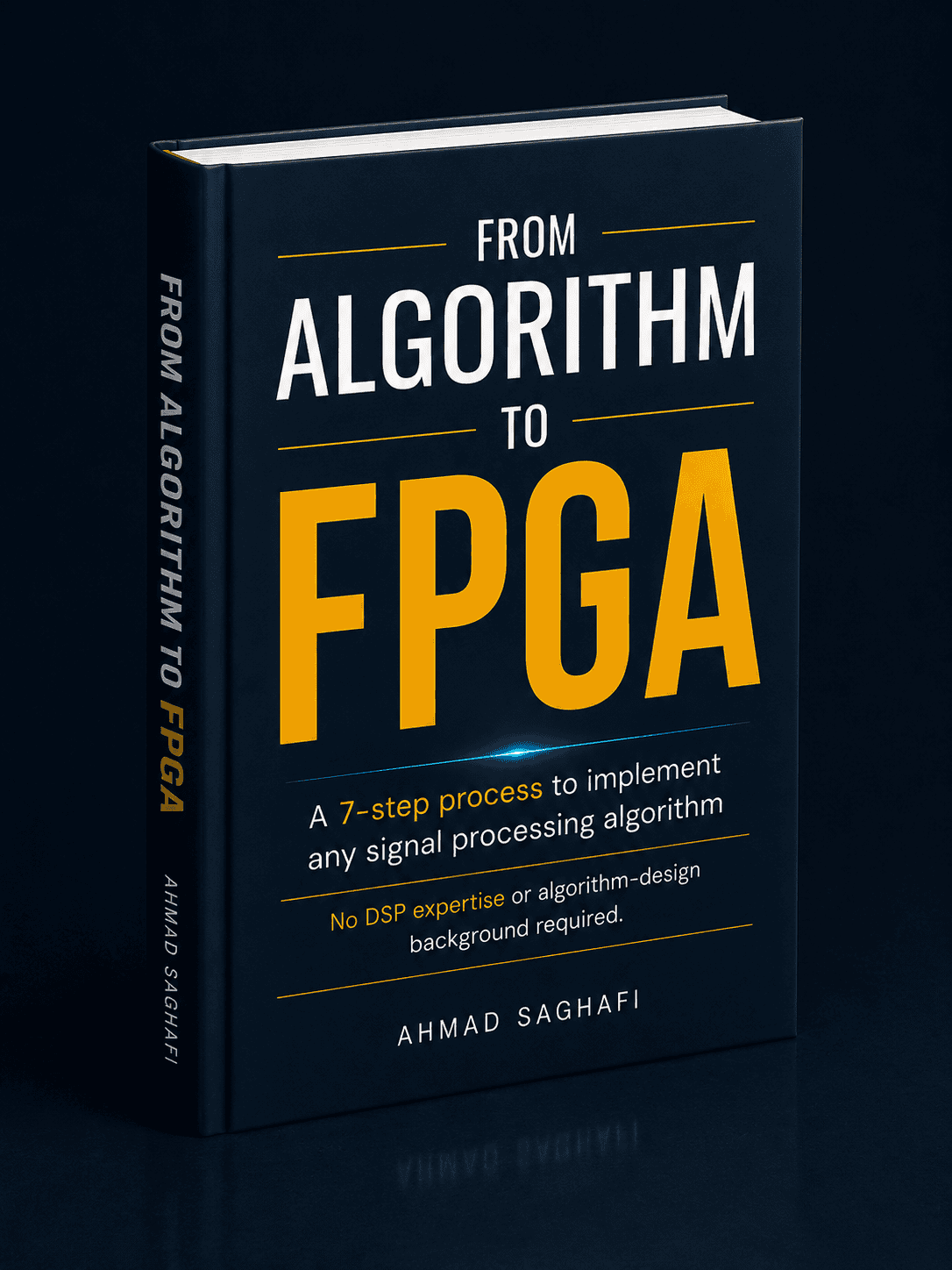
Most FPGA books hand you techniques. This one hands you a process — a single, repeatable, 7-step method for taking any signal processing algorithm to trustworthy hardware, the same way every time. At 160 pages you can read it in a weekend, and by the end the gap between "an algorithm" and "working, verified hardware" stops being the place your projects stall.
The idea that holds the entire method together is the golden model. At every stage you keep a reference you trust, and you check the next stage against it — floating-point model, then fixed-point golden model, then the HDL, each measured against the last.
You are never guessing whether your hardware is correct. You are measuring it. That single principle, more than any technique in the book, is what separates implementation that works from implementation that merely compiles.
THE GOLDEN-MODEL PRINCIPLEA way of thinking that generalizes.
What you're really walking away with isn't one solved example — it's a repeatable process. Point the 7 steps at a filter, an FFT, whatever lands on your desk, and it carries that algorithm to hardware the same disciplined way, every time.
The 7-Step Process
Deliberately general — the same seven moves take any algorithm from a floating-point model to proven hardware, not just this one worked example.
The s.m.n Method
A paper-based way to determine the exact format of every signal, coefficient, adder, and multiplier before you implement anything.
The Binary-Point Reframe
The binary point doesn't physically exist in your FPGA — it lives in your interpretation as the designer. Once that clicks, fixed-point becomes something you reason about instead of fear.
Here are the ideas you'll own by the end.
The golden-model principle — the habit that turns verification from a prayer into a measurement. You'll never again ship hardware you only hope is right.
The complete 7-step process — the repeatable method that turns FPGA signal processing from trial-and-error into engineering: the same seven moves take any algorithm from a floating-point model to proven hardware.
Why implementation should never begin with HDL — and what to build first instead. This one ordering decision is why experienced engineers' designs come out right and beginners' come out as weeks of debugging.
The reframe that makes all of fixed-point make sense — the binary point isn't in the silicon, it's in your interpretation. Miss this and every fixed-point design is guesswork; grasp it and the whole subject falls into place.
The s.m.n method — a paper-based way to determine the exact format of every signal, coefficient, adder, and multiplier before you implement anything, so you're never reverse-engineering why your numbers came out wrong.
The minimum-bit-width principle — why you almost never need floating-point precision, and how to decide, part by part, the fewest bits a design can use and still be correct. This decision is the optimization in FPGA DSP.
A measured way to quantize — reduce precision deliberately while watching the fixed-point and reference outputs, and stop at exactly the point where they begin to diverge. Precision by evidence, not by fear.
Why intermediate calculations can overflow and still give the exact right answer — the two's-complement property that lets you stop carrying unnecessary bits and build leaner hardware.
How far a little signal-processing understanding actually goes — you'll build only the DSP insight implementation genuinely demands, far less than the "master DSP theory first" crowd led you to believe.
Where this skill sits in the real world — the three engineering roles behind every DSP product, why two of them can't talk to each other, and how becoming the third makes you the person projects can't proceed without.
Reading teaches the process. This makes you do it once.
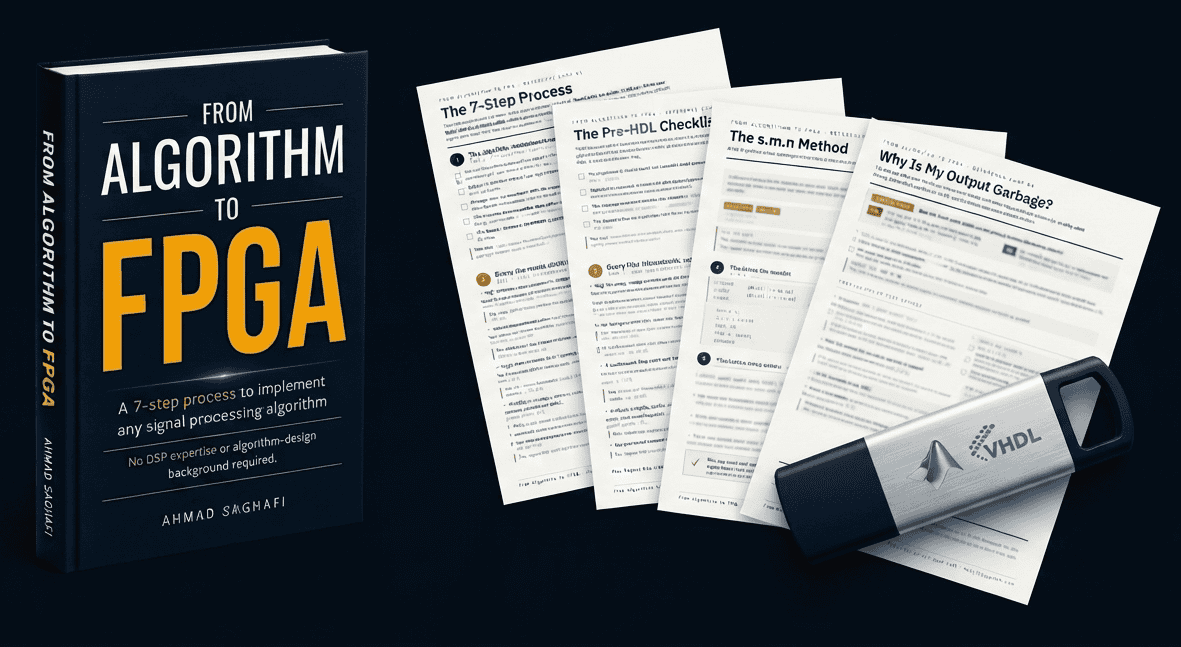
When you get the book today, you also get The Implementation Kit — everything you need to put the 7-step process to work the same day you read it.
Inside the KitThe complete worked-example project files — the actual MATLAB and VHDL folders, the stimulus vectors, the testbench, and the golden-vector files. You don't just follow the example, you run it on your own machine, break it, and watch your own hardware output land exactly on top of the golden model. That moment is the whole book in one image, and it happens on your screen instead of on the page.
The 7-Step Process Card — the entire method on one printable page, with the "what you must have before you move on" test for each step. Keep it beside the keyboard and you never lose your place in a project again.
The s.m.n Reference Card — the format rules for alignment, sign extension, concatenation, and multiplication on a single page. This is the one you'll still be using years from now, long after the method is second nature.
The Pre-HDL Checklist — every question that must be answered before you type a line of VHDL. It turns the book's most important principle — that implementation never begins with HDL — into something you actually do, not just something you agree with.
The "Why Is My Output Garbage?" diagnostic guide — a one-page field guide for the worst moment in any project: the numbers came out wrong and you don't know why. Match what you're seeing — a magnitude off by a power of two, sudden wraparound spikes, a grainy output, a signal that won't match on hardware — to its real cause and its fix, so you stop guessing and go straight to the source. This is the card people tell me was worth the price on its own.
Here's the honest reason the Kit exists: the gap between an engineer who has read a method and one who owns it is a single completed pass, start to finish. The book gives you the method. The Kit is how you make that pass this week instead of someday.
Here's what to do next.
The book is $7, delivered instantly as a download. The moment you order, the download link for the book and The Implementation Kit lands in your email — nothing ships, nothing to wait for.
From Algorithm to FPGA
- The complete book — 160 pages, instant PDF download
- The Implementation Kit — full worked-example MATLAB & VHDL project folders + 4 printable reference cards
- Backed by a full, no-questions-asked refund guarantee
Two questions worth answering honestly.
Why is a serious technical book only $7?
There's no catch, and I'll tell you plainly why the price is this low. I'd rather get a method that actually works into the hands of the exact engineers who need it than wall it off behind a big price tag — and a portion of the people who read it, get real results, and want to go further end up working with me directly. That's my motivation, and I'd rather just say so than pretend I don't have one. No subscription slipped in, nothing to fight off to get what you paid for.
What if my algorithm is completely different from the example?
That's exactly why the whole method is taught as one example carried end to end, with the files in your hands. By the last page you won't be wondering whether you can do it. You'll have already done it once, completely. And because the process is general by design, the same seven steps that carried this example carry the next one you're handed.

Ahmad Saghafi
Ahmad Saghafi is an FPGA design expert, educator, and entrepreneur with over 15 years of experience in digital circuit design and FPGA implementation.
He is the founder of FPGATEK.com, the creator of the FPGA Design Blueprint training program, the author of From Algorithm to FPGA, and the creator of FPGA LAB, where engineers complete a full real-world FPGA project under his guidance.
Throughout his career, Ahmad has helped engineers bridge the gap between theory and practical implementation by teaching the workflows and design techniques used in professional FPGA development. His signature FPGA Design Template and hands-on teaching approach have helped countless engineers build reliable, high-performance digital systems.
His mission is to help engineers master FPGA design with practical, industry-focused training that prepares them to tackle real-world engineering projects with confidence.
Try It Risk-Free.
Yes, there's a guarantee, about as bold as they come. Read the book, run the Kit, put the 7-step method to work. If you don't find it was worth many times $7, email me and I'll refund every cent — and you keep the book and the Kit anyway. You don't send anything back. There's no way for you to lose here.
This offer is a test — grab it while it's in front of you.
It costs me real money in advertising to put this book in front of the right engineer, so this is a test, and the price could change or come down at any time. If it's in front of you now, now is the moment.
P.S.In case you skipped to the bottom: you're getting From Algorithm to FPGA, the book that hands you a complete, repeatable 7-step method for taking any signal processing algorithm to FPGA hardware you can prove is correct — even without a DSP background — built on the golden-model principle, the s.m.n analysis method, and a way of thinking about fixed-point that turns guesswork into engineering.
It's 160 pages, $7, an instant download, and it comes with The Implementation Kit — the complete worked-example project files plus four printable cards you'll keep beside the keyboard. If it isn't worth many times the price, I'll refund you and you keep everything. And if it makes you want to put the method to work on a real project with someone in your corner — that's what FPGA Lab is for, and we'll talk. For now: grab the book.
→ Send Me The Book